

Many business owners come to us without understanding the importance of organizational structure—or even what that might look like in their business. They only know that things aren’t working the way they want them to and their people aren’t measuring up: There’s no teamwork, tasks are constantly missed, their people come to them for everything—or work too independently. The list goes on.

If you routinely struggle with this type of confusion and underperformance among your employees, it’s a sign that the functions of your business are tied to people, not systems of your design. An organization chart turns that around. It helps you objectively see the functions, positions and responsibilities you need in your business so you can create a strategy for how it operates. The right strategy is to help you systematize your own way of operating the business without you holding all (or any) of the functions within it. This is what a systems-dependent business looks like.
What is a people-dependent business?
If you own a small business, it’s quite likely that it’s people-dependent. You might even think, “Of course it is. I can’t do it all. I need people to make it run.” But people-dependency doesn’t come from your need for people. It comes from the happenstance way that many people are brought into small businesses—to fill immediate functional gaps rather than thoughtfully designed roles.
For example, it’s not uncommon to hear an EMyth Client say something like: I need to hire someone to replace Dustin—they need to be able to do bookkeeping and sales, and change the oil in the company vehicles. These are functions of three completely different roles, but many roles develop by default based on the abilities and availability of individual employees. If you hired Dustin for sales, but he became the only person you trusted to keep the books, and he also enjoyed maintaining the company cars, then you don’t need to hire another salesperson—you need another Dustin. And you’re never going to find one.
That’s the danger of people-dependency: You end up with a team of people, all of whom have custom roles born out of the needs of the business at a specific moment in time. There’s confusion over who reports to whom, people step on each other’s toes, and important responsibilities are missed because they don’t fit specifically into anyone’s role.
Most companies organize around personalities rather than around functions. That is, around people rather than accountabilities or responsibilities. The result is almost always chaos.
Michael E. Gerber, "The E-Myth Revisited"
Why is it important to have an organization chart?
You can work your way out of being a people-dependent business by creating an organization chart—sometimes referred to as a company structure chart or company org chart—that defines roles and creates clear structure between them. Your organization chart is a visual diagram or graph depicting your company’s organizational strategy.
When we first work with clients to design their organizational chart, some become panic-stricken. Why? Because they’ve just realized that they don’t have defined roles within their company. Their org chart looks more like a spider web: a mess of lines, boxes, job titles and names. Everything overlaps. It's chaotic. And quite often, it looks like this:
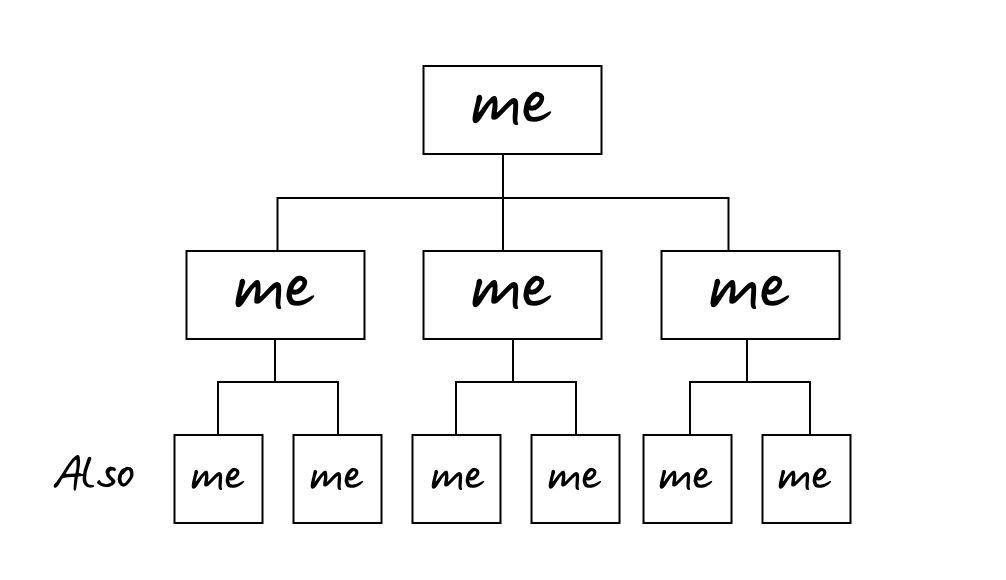
This is usually the point when they can clearly see that their name is in most of the boxes—that essentially, they're doing most of the work.
Your organization chart is like the grand schematic of your business, and one that you should gradually write yourself out of as you make strategic hires. Ideally, your chart should:
- Be the visual representation of your strategy.
- Reflect all of your business systems, stated in terms of the results they reach.
- Show a cohesive unit that’s working in concert for a common objective.
- Clarify the broad accountabilities of every position in your company and their interrelationships.
Remember, to build a thriving business, you need to find other people to do the Tactical Work so your time is free to do the Strategic Work. Your organization chart is the means through which you can make that crucial transition.
Four tips to creating your organization chart
1. Keep "owner" out of it
Don’t label any box on the chart with "owner." If you’re the business owner, you’re surely going to occupy one or more boxes on the chart—but those boxes should have official titles like “CEO”, “Director of Sales” or “Lead Trainer”, and should follow the same rules for you as they would for any other employee.
2. One manager per person
Ensure that every position on the chart reports to one (and only one) manager. Giving two or more managers the power to direct the activities of one employee is an invitation for miscommunication and chaos.
3. Focus on work, not individuals
Divide up the work according to what the business needs. Don't try to design a position to fit the particular talents of one individual. If (when) that person leaves, you'll have to start all over with a new chart because you won't be able to find an identical candidate to replace them.
4. Create simple titles
When creating titles, give managers titles such as vice president, director or manager, followed by the department name. Keep non-managerial position titles more specific and descriptive of the actual work performed, such as bookkeeper, plumbing technician or engineer.
Build for now with an eye to the future
Once you have a working organization chart, the next step is to figure out how that chart is going to serve the future of your business. We refer to this as Double Vision: keeping in mind how the present is going to serve your future vision of your business. Every leader has to balance these two perspectives of their business—the reality, challenges and concerns of what exists today, and goals for the year(s) to come. The more you’re able to balance the important work with the urgent tasks, the better you’ll be able to face present situations strategically.
Take some time to sketch out a chart of your organizational structure as it exists today. What does the image tell you about your business? If you’d like to discuss how to design an organizational chart that supports your vision for your business and life, we’d love to hear from you.

Comments